
The Expat’s Guide to In-Kind Roth Conversions:
Transferring High-Yield Stocks from a 401(k) to a ROTH IRA
Summary
This article serves as a comprehensive guide for U.S. expatriates considering transferring high-yield or appreciated stocks from a 401(k) to a Roth IRA. It explains the mechanics of in-kind conversions, which allow investors to move assets without selling them, provided their financial custodians support the maneuver. The focus is on the tax implications, noting that the IRS taxes the full market value of the shares as ordinary income, regardless of the original purchase price. For those living abroad, the guide highlights the critical risk that foreign jurisdictions may not recognize the Roth’s tax-free status, potentially leading to double taxation. Mathematical frameworks are provided to help readers calculate a break-even point by comparing current and future tax rates. Finally, it cautions against complex strategies like Net Unrealized Appreciation for expats, suggesting that simpler conversion methods are often safer under international tax treaties.
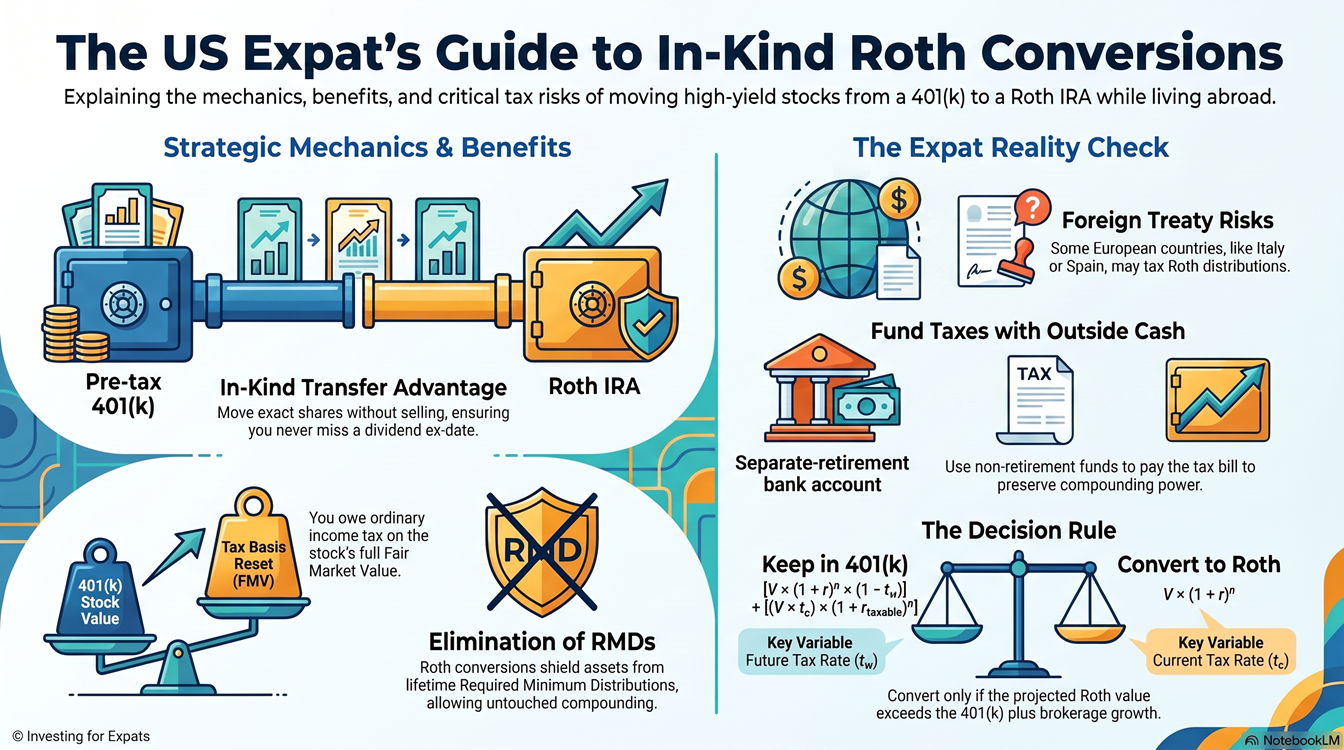
In-Kind Roth conversion for the American expat
An attractive proposition
If you hold a high-dividend paying stock inside a traditional (pre-tax) 401(k) that you acquired at a remarkably low price, executing an in-kind transfer to a Roth IRA is an attractive proposition. Moving the asset "in-kind" lets you transfer the exact shares from one account to another without ever selling them, keeping you in the market and ensuring you never miss a dividend ex-date.
However, transferring assets across tax boundaries—especially as a US expat—requires careful mathematical and jurisdictional planning.
Plan/custodian feasibility caveat
Before running any of the math below, confirm the mechanics are actually available to you. Not every 401(k) plan permits in-kind distributions, and even when a plan does, your Roth IRA custodian must be able to accept that exact security into the account. If either side can't handle an in-kind transfer, the plan will force a liquidation — you'll sell the shares, convert the cash, and repurchase the position in the Roth, which exposes you to market movement and a brief period out of the stock. Check with both your 401(k) administrator and your Roth IRA custodian before assuming this is a clean, share-for-share transfer.
The "Low Price" Reality & Yield Illusion
A common misconception is that transferring a stock bought at a very low price provides a tax advantage. Inside a pre-tax 401(k), the IRS does not recognize capital gains or cost basis. If you convert this asset to a Roth IRA, you owe ordinary income tax on the total Fair Market Value (FMV) of the stock on the exact day of the conversion.
Here's a concrete example of why this matters. Say you bought the stock years ago at $10 a share, and it's now worth $100 a share at conversion, paying a $4 annual dividend. Before conversion, your yield on your original cost was 40% ($4 ÷ $10). After conversion, the IRS resets your basis to $100 — the FMV on the conversion date — so if you recalculate yield on that new basis, it drops to 4% ($4 ÷ $100). Nothing about the stock changed: you still own the same shares and still collect the same $4. The "lower yield" is purely an artifact of the new basis, not a reduction in income.
Weighing the Conversion
The Advantages
Tax-Free Income: The primary advantage for a high-yield stock is that all future dividends are paid into the Roth IRA completely tax-free under US law.
Estate Planning: A Roth IRA shields the asset from lifetime Required Minimum Distributions (RMDs), allowing the high-dividend stock to compound untouched.If inherited, most non-spouse heirs must deplete the account within 10 years — but distributions are only tax-free if the Roth has satisfied the 5-year holding period, measured from the date of your first-ever Roth contribution or conversion, not the date of this specific transfer. If you convert and pass away before that 5-year clock runs out, your heirs' withdrawals of the earnings portion remain taxable until the 5-year mark is reached, even though the account is a Roth. Note that the 10-year rule doesn't apply to every heir. Spouses, minor children of the original owner, disabled or chronically ill beneficiaries, and heirs less than 10 years younger than you are classified as "eligible designated beneficiaries" and can stretch distributions over their own lifetime instead of the compressed 10-year window.
The Risks
Upfront Tax Burden: The entire market value of the stock is added to your taxable income for the year. Fortunately, because the individual tax provisions from the TCJA were permanently extended under the One Big Beautiful Bill Act (OBBBA), current marginal tax brackets offer a stable, predictable horizon for calculating this exact tax burden.
Funding the Tax: To optimize the math, you must pay the conversion tax with cash from outside your retirement accounts. Selling stock inside the Roth to cover taxes destroys the compounding power of those shares.
Withholding Mechanics: Because an in-kind conversion is a direct, trustee-to-trustee transfer rather than a distribution paid to you personally, it isn't subject to the mandatory 20% federal withholding that applies to indirect (60-day) rollovers. That's actually why you need outside cash to cover the tax in the first place — no withholding is taken from the shares themselves, so the full tax bill falls due when you file, unless you make estimated payments beforehand.
⚠️ Critical Warning for US Expats in Europe
Many US expats assume that a Roth IRA will automatically shield their wealth from taxation globally. However, many European countries do not recognize the tax-free nature of a Roth IRA. Without specific protection from a bilateral tax treaty, foreign tax authorities often view Roth distributions as taxable investment income or ordinary pension distributions. For instance, countries like Italy or Spain may tax the earnings portion of a Roth IRA withdrawal, effectively stripping away the core tax advantage you paid upfront to secure. Always review the specific tax treaty of your resident country before initiating a conversion. Here is the short list of European countries that recognize the tax-free nature of the Roth IRA.
Calculating the Breakeven Point
To determine if the transfer is "convenient" (financially optimal), you must project the future after-tax value of the asset under both scenarios.
The most critical factor is the comparison between your current tax rate and your anticipated tax rate in retirement.
Here is the mathematical framework to calculate the breakeven point.
The Variables:
\(V\) = Current total market value of the stock (at time of transfer)
\(r\) = Expected annualized return (capital appreciation + dividends)
\(n\) = Number of years until withdrawal
\(t_c\) = Your current marginal tax rate applied to the conversion amount
\(t_w\) = Your expected marginal tax rate during retirement withdrawals
\(r_{taxable}\) = The after-tax return on a standard brokerage account
Roth Conversion Break-Even Calculator
Calculate the most tax-efficient path for your retirement assets.
Use the calculator below to easily compare keeping the shares in a traditional 401(k) versus transferring them to a Roth IRA.
Note that the "Brokerage Return" Field represents the after-tax growth on the money you didn't spend on conversion taxes today. It is critical for an accurate mathematical comparison and is often left out of over-simplified calculators.
Explanation
To determine if the transfer is financially optimal, you must project the future after-tax value of the asset under both scenarios.
Scenario A: Keep in Traditional 401(k)
You pay no tax today. Upon withdrawal, the balance is taxed at your future rate. The cash you saved by not paying taxes today is invested in a taxable brokerage account .
$$FV_{Trad} = [V \times (1 + r)^n \times (1 - t_w)] + [(V \times t_c) \times (1 + r_{taxable})^n]$$
Scenario B: Convert to Roth IRA You transfer the stock and pay the conversion tax today using outside cash. The stock grows and pays dividends completely tax-free inside the Roth IRA.
$$FV_{\text{Roth}} = V \times (1 + r)^n$$
The Decision Rule: The transfer is financially advantageous if $$FV_{\text{Roth}} > FV_{\text{Trad}}$$
If you expect your future tax rate to be higher than your current tax rate, the Roth conversion is almost always the winner. However, as an expat, you must factor your resident country's tax treatment of the final withdrawal to accurately project your true after-tax wealth.
One important limitation of this model: \(t_c\) assumes your entire conversion is taxed at a single flat marginal rate. In practice, converting an entire stock position in one year usually pushes your income through several brackets at once — the first dollars converted may be taxed at your current marginal rate, but the last dollars could easily land in the bracket above it. For a large position, it's worth re-running this calculation using a blended or effective rate rather than your current top marginal rate, or splitting the conversion across multiple tax years to avoid bracket creep. If you're near or already on Medicare, also factor in IRMAA: a large one-time spike in income can trigger higher Medicare Part B and Part D premiums two years later, a cost this formula doesn't capture.
Navigating the RMD "First Money Out" Rule
If you are already in the required minimum distribution (RMD) phase, the IRS enforces a strict "first money out" rule: You cannot convert an RMD.
The first dollars distributed from your 401(k) in any given year are classified as your RMD. Before you can transfer your high-dividend stock in-kind to a Roth IRA, you must fully satisfy your RMD for the current year. If you attempt the conversion first, the IRS will treat the RMD portion as an excess contribution to the Roth IRA, triggering a 6% annual penalty until the error is corrected.
Once the current year's RMD is satisfied, converting the stock permanently removes its value—and all future dividend payments—from your pre-tax RMD calculation for all subsequent years.
Recalculating the "Convenience"
In the RMD phase, the formula for deciding if the transfer is optimal simplifies. The decision hinges almost entirely on comparing your current marginal tax rate against the future marginal tax rate of whoever will ultimately spend the money.
If you will spend it: If your current tax rate is lower than the rate you expect to face later in retirement (perhaps due to the death of a spouse, which changes your filing status from Joint to Single), converting now locks in the lower rate.
If your heirs will spend it: If your heirs are in their peak earning years and face a higher marginal tax bracket than you do right now, paying the conversion tax at your lower rate is a massive financial gift to them.
If the opposite is true: If your heirs are in a lower tax bracket than you, it is generally more efficient to leave the stock in the 401(k), take your required RMDs, and let the heirs pay the taxes at their lower rates later.
Highly-appreciated stocks
The exact same reasoning applies if highly appreciated stocks are held within a pre-tax 401(k). The IRS does not track cost basis, capital gains, or "appreciation" inside a pre-tax retirement account.
The NUA Exception: if the stock comprises shares of your current or former employer's company, the Special Net Unrealized Appreciation (NUA) tax rules apply. Net Unrealized Appreciation (NUA) is a specialized tax rule that applies to highly appreciated company stock held inside an employer-sponsored retirement plan, such as a 401(k) or Employee Stock Ownership Plan (ESOP).
Normally, any withdrawals from a pre-tax 401(k) are taxed entirely as ordinary income. The NUA strategy allows you to separate the original cost of the company stock from its accumulated growth, shifting the taxation on the stock's growth from your higher ordinary income tax rate to the typically much lower long-term capital gains tax rate.
The NUA strategy is arguably the worst-suited US tax play for an expat to attempt from abroad — more fragile, in cross-border terms, than a standard Roth conversion. A Roth IRA at least has some chance of treaty protection in certain countries; NUA has essentially none. It exists only as a narrow carve-out inside the US Internal Revenue Code (specifically, how lump-sum distributions of employer stock are taxed), and no foreign tax authority is a party to that carve-out. Your country of residence will simply tax the distribution under its own domestic rules for capital income, pension income, or investment gains — whichever category it falls into locally — with zero regard for how the IRS splits the cost basis from the appreciation.
In practice, this means you could pay favorable long-term capital gains treatment on the appreciation in the US, while your resident country taxes that same appreciation as ordinary income at home, with no matching foreign tax credit to offset the mismatch (since the two governments aren't taxing the same "layer" of the transaction the same way). The result is a real risk of double taxation that isn't just theoretical — it's the default outcome unless you've confirmed otherwise.
The practical takeaway: if you're a US expat living in Europe and holding significant employer stock inside a 401(k) or ESOP, get a cross-border tax opinion — from someone who understands both sides of the treaty, not just the US side — before triggering an NUA distribution. In most cases, a standard rollover to a Traditional or Roth IRA, taxed under the simpler ordinary-income or conversion rules covered earlier in this article, will be easier to defend to a foreign tax authority than a US-specific carve-out they have no framework for recognizing.
Highly Appreciated Stocks in a Taxable Brokerage
If the highly appreciated stocks are held outside a retirement account (e.g., in a standard taxable brokerage account), the reasoning changes completely.
No In-Kind Contributions: You cannot transfer shares of stock from a taxable brokerage account directly into a Roth IRA. IRS rules strictly require that all standard Roth IRA contributions be made in cash.
The Taxable Event: To move this wealth into a Roth IRA, you would first have to sell the highly appreciated stock, triggering capital gains taxes on the appreciation. You would then contribute the remaining cash, which is subject to strict annual IRA contribution limits.
Last Updated: Jul. 26, 2026