
European Countries with U.S. Totalization Agreements
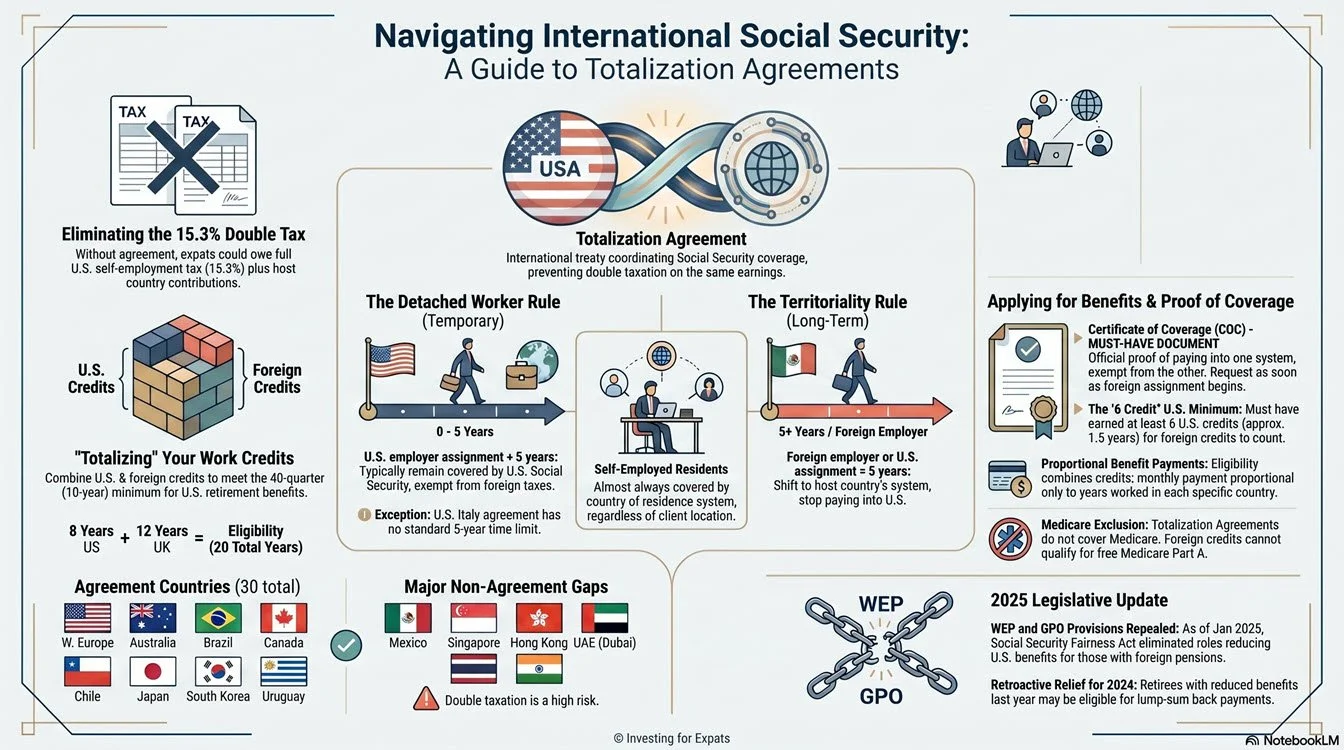
International Social Security Totalization Agreements
Social Security Totalization Agreements are bilateral international treaties designed to coordinate social security coverage across national borders. For expats, cross-border remote workers, and multinational employers, they solve two specific financial headaches: dual taxation and coverage gaps.
How Social Security Totalization Agreements Work
These agreements establish clear ground rules to determine exactly which country has the right to collect payroll/social insurance taxes and which country is responsible for paying out eventual benefits.
They operate on two primary mechanisms:
1. Eliminating Dual Taxation (The Coverage Rules)
Without an agreement, a U.S. citizen working abroad could easily face double exposure—paying both U.S. Self-Employment tax (15.3% SECA) or payroll tax (FICA) and the host country's local social insurance charges on the very same income. Totalization agreements eliminate this by assigning coverage to just one country based on two main principles:
The Territoriality Rule: By default, you are subject to the social security taxes of the country where you are physically performing the work. If you are hired locally by a foreign entity or reside long-term as a freelancer in an agreement country, you pay into that local system and are exempt from U.S. FICA/SECA.
The Detached Worker Rule: If a U.S. employer sends an employee on a temporary assignment to an agreement country for 5 years or less, the worker remains covered by U.S. Social Security and is exempt from the host nation's social taxes.
Procedural Note: To legally claim an exemption from one country's social tax under these rules, the worker or employer must formally apply for and secure a Certificate of Coverage from the home country’s social security authority to present to the host country.
2. Filling Coverage Gaps (The Totalization Benefit Rules)
To qualify for U.S. Social Security retirement benefits, you typically need 40 lifetime work credits (roughly 10 years of work). Many foreign pension systems require similar long-term vesting periods.
If you split your career between two nations, you might end up short of the minimum threshold in both systems, leaving you with nothing. Totalization agreements allow countries to combine (totalize) your credits to help you qualify:
If you have at least 6 U.S. credits but fewer than 40, the Social Security Administration (SSA) can look at your foreign work history to bridge the gap.
Your credits are never actually transferred or lost; they remain on record where earned.
If you qualify via combined credits, each country pays a proportional (prorated) benefit based strictly on the earnings and time spent inside its own system.
European Countries with U.S. Totalization Agreements
The United States currently has Social Security Totalization Agreements in effect with 24 European jurisdictions.
EU countries with Social U.S. Security Agreements
Key Legislative Nuances to Note
The Italy Exception: The U.S.–Italy agreement handles coverage differently than most. Instead of a strict 5-year cap on the detached worker rule, it relies heavily on the worker's nationality and where the employer is established, allowing for longer exemptions under specific conditions.
France Social Charges: While France is an agreement country, the IRS and French authorities have clarified that specific French surtaxes—namely the CSG (Contribution Sociale Généralisée) and CRDS (Contribution au Remboursement de la Dette Sociale)—are classified as income taxes rather than social insurance taxes under the treaty terms.
Windfall Elimination Provision (WEP)
The Social Security Fairness Act, which was signed into law on January 5, 2025 has completely repealed the Windfall Elimination Provision (WEP), as well as the Government Pension Offset (GPO), with a retroactive effective date of January 2024.
Multiple countries Totalization Agreements
The United States does not allow or participate in multi-country (multilateral or tripartite) Totalization Agreements.
By statutory design under Section 233 of the Social Security Act, U.S. Totalization Agreements must strictly be bilateral—meaning they are exclusive, two-party treaties negotiated directly between the United States and one foreign government.
European "Multi-Country" Rules Do Not Apply to the U.S.
If you are used to how social security works within Europe, this bilateral restriction can be frustrating. Inside the EU/EEA (and under certain post-Brexit rules with the UK), countries participate in a sweeping multilateral coordination framework (EU Regulation 883/2004).
Under EU rules, a worker can combine parts of a career, for example, from Malta, Germany, France, and the UK to build a single, unified multi-country totalized pension. However, the U.S. is completely locked out of this European network. The U.S. cannot piggyback on the EU’s multilateral rules.
The Planning Takeaway: When mapping out a multi-country career that touches the United States, you must evaluate your social security exposure as a series of isolated, two-country relationships.
-
Wagenmaker & Oberly
Totalization Agreements: International Social Security Tax Compliance
Greenback Expat Tax Services
Totalization Agreements Explained: How Expats Avoid Paying Double Social Security Tax
Siskind Susser
U.S. Embassy In Poland
Totalization Agreements - U.S. Embassy In Poland
Social Security Administration
Totalization Agreements - Social Security Administration
IRS
Last updated: May 20, 2026