
US-Italy Social Security Totalization Agreement
Questions?
Feel free to ask here
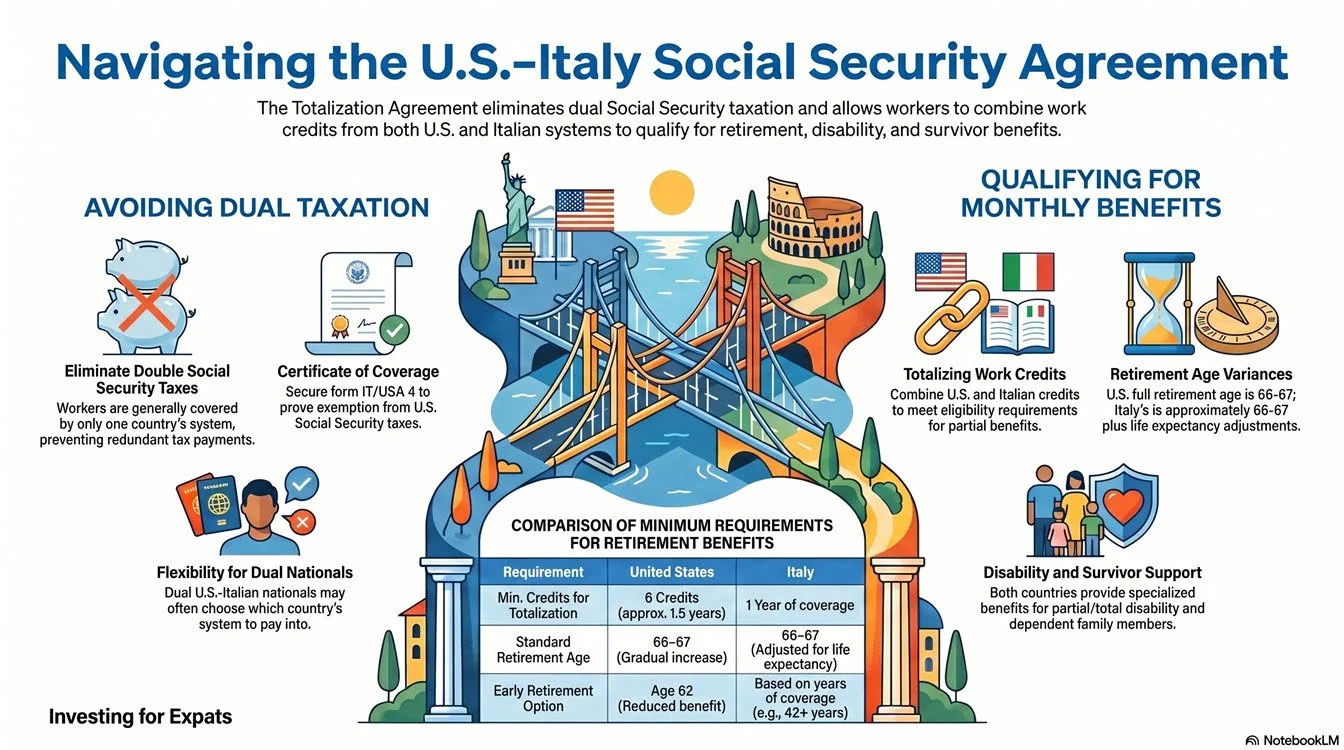
The US-Italy Social Security Totalization Agreement is a unique beast in the world of international social security treaties. While most of the 30+ agreements the US has signed follow a predictable script, the Italian agreement—originally signed in 1973 and effective since 1978—operates on an entirely different logic.
As an expat or advisor, understanding this "black swan" of treaties is essential, as the standard "5-year rule" you likely rely on for other European countries simply does not apply here.
1. The Core Difference: Nationality vs. Time
In almost every other US totalization agreement (like those with the UK, Germany, or Portugal), the primary rule for "detached workers" is the 5-Year Rule. If a US company sends you to London for 4 years, you stay in the US Social Security system. If the assignment is planned for 6 years, you switch to the UK system.
Italy ignores the clock. Instead, it looks at your passport.
Under the US-Italy Agreement, the determination of which system you pay into is based primarily on your citizenship and the nationality of your employer, rather than the length of your stay.
US Nationals: If you are a US citizen working in Italy for a US employer, you remain covered by US Social Security regardless of whether you stay for 2 years or 20 years.
Italian Nationals: Conversely, an Italian national working in the US for an Italian firm remains under the Italian system (INPS).
2. The Power of Election
Perhaps the most "Italian" aspect of this agreement is the Election Provision. This is a rare feature not found in standard agreements.
If you are a dual US-Italian citizen or an Italian national working in a situation where both systems could technically claim you, you often have the right to choose which system to contribute to.
Sage Advice: This election is not a "set it and forget it" checkbox. For dual nationals, choosing the US system might be cheaper (7.65% vs. Italy's higher rates), but choosing the Italian system might offer more robust local health benefits or a faster path to an EU pension.
3. Totalization: Filling the "Quarter" Gaps
The "Totalization" part of the agreement works to ensure you don't lose your right to a pension just because you split your life between two countries.
The US Side: To qualify for US Social Security, you normally need 40 credits (10 years). Under the agreement, if you have at least 6 quarters (1.5 years) of US coverage, the SSA will "count" your Italian work years to help you meet that 40-credit threshold.
The Italy Side: Italy generally requires 20 years of contributions for a standard old-age pension. If you only have 15 years in Italy but 5 in the US, Italy will totalize those years to grant you a pro-rata Italian pension.
4. What is Missing? (The Medicare Trap)
While the agreement covers Social Security and Medicare taxes, it does not cover Medicare benefits.
Even if you pay Medicare taxes while working in Italy to keep your US record clean, you cannot use Medicare to pay for a doctor in Rome. Furthermore, the agreement does not cover Supplemental Security Income (SSI).
5. 2026 Key Figures for Expats
If you are currently managing your contributions for the 2026 tax year, keep these thresholds in mind:
Social Security Wage Base: For 2026, the US Social Security tax (6.2%) applies only to the first $184,500 of your earnings.
Self-Employment Tax: If you are a self-employed US expat in Italy, you are generally covered by the country where you reside. However, if you are a US citizen, you must proactively obtain a Certificate of Coverage to avoid the 15.3% US self-employment tax.
Why this matters now
In 2026, with the "One Big Beautiful Bill Act" (OBBBA) having stabilized many US tax provisions, the interplay between high Italian social contributions and US credits is more critical than ever. For high-earners, the lack of a 5-year "cliff" in Italy means you can stay in the US system indefinitely—potentially saving hundreds of thousands in lifetime contributions compared to the Italian system, provided you are working for a US-based entity.
Questions? Feel free to ask here
-
Totalization agreements - Wikipedia
Totalization Agreements Explained: How Expats Avoid Paying Double Social Security Tax
What is Social Security Tax? Totalization & Self-Employment Tax - Taxes for Expats
Totalization Agreements Explained: How Expats Avoid Paying Double Social Security Tax
How Totalization Agreements Affect Your Social Security as a U.S. Expat - Bright!Tax
Totalization Agreements Explained: How Expats Avoid Paying Double Social Security Tax
Last Updated: April 22, 2026